Peppered Moths
Natural selection is bookkeeping, not intent. You are the bird. Eat the moths you can see, breed the survivors, and watch the population shift under your own beak.
The era advances on its own every 4 generations. After generation 12 the buttons unlock and you can keep breeding as long as you like.
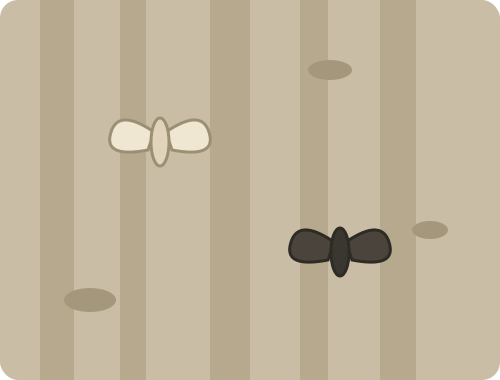
The bark — click a moth to eat it
This generation
Dark moths per generation
generation 1full height = all dark
How this works: twenty moths sit on bark at random positions. Moths that contrast with the bark are easier for you to spot, so they get eaten more. The next generation is drawn from the survivors' color frequency, with a fifth of each new generation arriving from neighboring woodland. That gene flow is real, and it also keeps both forms available so a later era still has something to select on. The model tracks the population's color mix rather than individual genotypes. Population size and catches per round are fixed so the simulation cannot be broken. The even starting mix is a demonstration choice rather than the historical frequency; real pre-industrial populations were almost entirely pale.
Industrial melanism, the case everyone cites
Before the 1800s, almost every peppered moth in Britain was pale and speckled, which matched the lichen on the trees it rested on. Coal soot killed the lichen and darkened the bark, and within a few decades dark moths went from rare to dominant near industrial cities. After the Clean Air Acts of the mid-twentieth century the bark lightened again, and the pale form recovered. Field biologists watched the whole reversal happen, which is what makes this the textbook case: selection observed in a wild population, in both directions, on a timescale a person can live through.
The important part is what selection did not do. No moth changed color to hide better, and soot did not cause dark moths to appear. Both forms already existed in the population, produced by an ordinary genetic difference. Changing the bark changed only which of the two got eaten first, and eating is the whole mechanism. Selection sorts variation that is already there, generation after generation, and the population average drifts as a side effect of who survived to breed.
This simulation is honest about being simple. Real inheritance in peppered moths runs on a single dominant allele. This model does not track alleles at all. It measures the color mix of whoever survived and draws the next generation from that, which reproduces the trend without the genetics. Real populations also move between trees, face several predators, and number in the thousands. Twenty moths and a fixed budget of five catches per generation will not give you publication-grade numbers. Twelve generations give you the shape of the effect. The bark changes under you twice, once when the soot arrives and once when it clears, and the population chases each change a few generations behind.